See also:
Music, Sounds, Sound-Art, Soundtrack and other nice things to hear and listen... Visit my website: www.duklingstgut.de
Showing posts with label Music theorie. Show all posts
Wednesday, April 7, 2021
Friday, September 11, 2020
Monday, August 28, 2017
Artist Bartholomaus Traubeck has created musical masterpieces, by playing trees.
He created a record player that translates the different colors and textures of tree rings into music. Rather than use a needle like a record, sensors gather information about the wood and turn them into piano notes.
Every tree sounds vastly unique due to varying characteristics of the rings, such as strength, thickness and rate of growth.
YEARS from Bartholomäus Traubeck on Vimeo.
via: http://educateinspirechange.org/science-technology/musical-trees-tree-sounds-like/
YEARS from Bartholomäus Traubeck on Vimeo.
via: http://educateinspirechange.org/science-technology/musical-trees-tree-sounds-like/
Labels:
Interactive Sounds,
Music tech,
Music theorie,
perception,
Sound Art
Friday, June 16, 2017
Friday, March 10, 2017
Tuesday, December 8, 2015
Birds playing guitar...
Céleste Boursier-Mougenot at the montreal museum of fine arts.
in english:
http://www.mbam.qc.ca/en/exhibitions/on-view/celeste-boursier-mougenot/
in french:
http://ici.radio-canada.ca/nouvelles/arts_et_spectacles/2015/11/23/005-oiseaux-guitares-installation-mbam.shtml
in english:
http://www.mbam.qc.ca/en/exhibitions/on-view/celeste-boursier-mougenot/
in french:
http://ici.radio-canada.ca/nouvelles/arts_et_spectacles/2015/11/23/005-oiseaux-guitares-installation-mbam.shtml
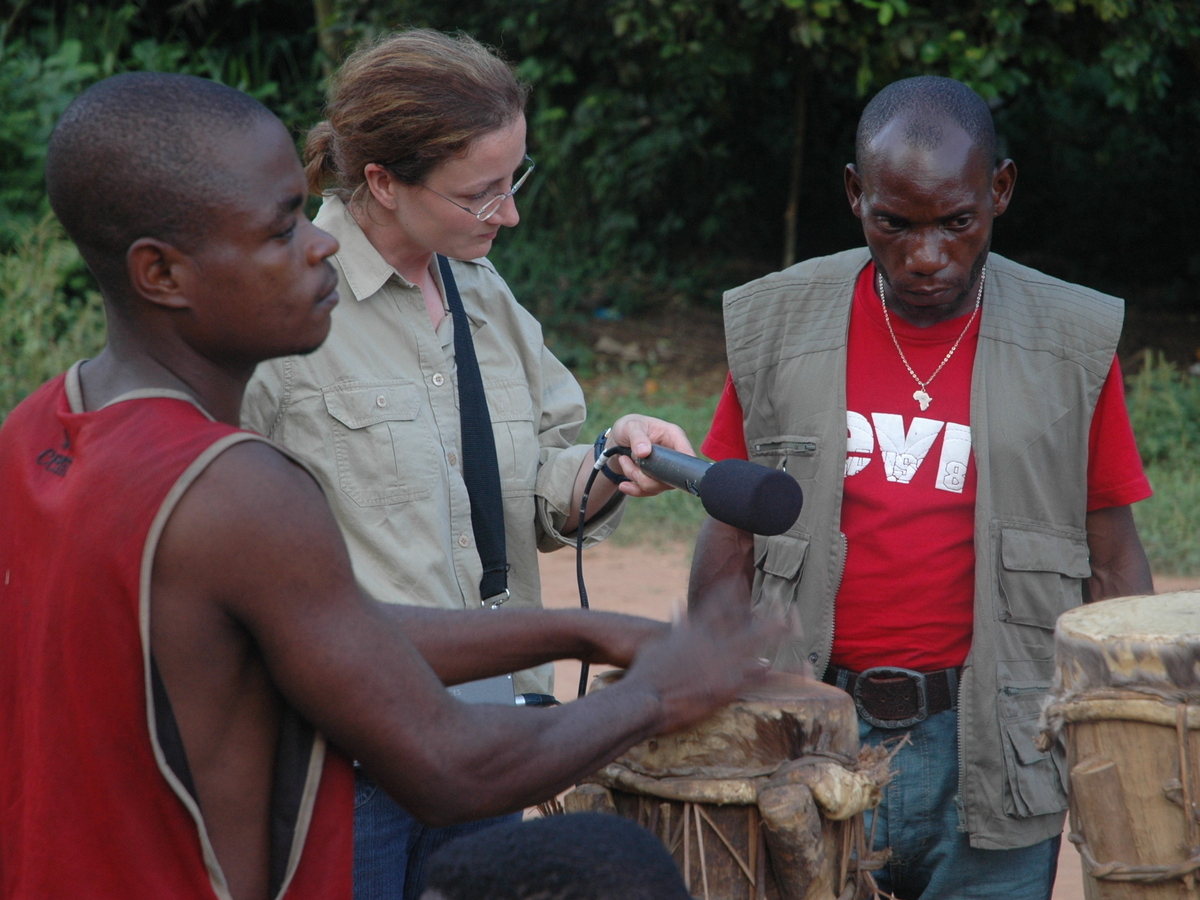
All you need to know about the Drum Language of the Congo
The Lokele people of the Congo use two-tone log drums to communicate phrases in their language. They can accomplish this because their language is tonal. That is, each syllable in a word has a high or low tone. The tonal patterns that result in their speech are the same tonal patterns that they drum. By communicating in this way, they create drum language in which their vocabulary is always understood in the context of phrases. Listen to Phil explain how this works by pressing the Play button below.
Visit the page of Phil Tulga:
http://www.philtulga.com/Talking%20with%20Drums.html
Visit the page of Phil Tulga:
http://www.philtulga.com/Talking%20with%20Drums.html
Tuesday, March 24, 2015
Why Pygmies Aren't Scared By The 'Psycho' Theme
I found this interesting article about music & perception written by Michaeleen Doucleff:
Try listening to the Star Wars' Cantina Band song without smiling, or to the Psycho soundtrack without feeling a little tense.
But what if you had never heard Western music before. Would these songs still make you feel the same way?
http://www.npr.org/blogs/goatsandsoda/2015/01/09/375418410/why-pygmies-arent-scared-by-the-psycho-theme?utm_campaign=storyshare&utm_source=twitter.com&utm_medium=social
Try listening to the Star Wars' Cantina Band song without smiling, or to the Psycho soundtrack without feeling a little tense.
But what if you had never heard Western music before. Would these songs still make you feel the same way?
Scientists at McGill University and the University of Montreal got the rare opportunity to answer that question. Their findings, published Wednesday in Frontiers in Psychology, suggest that music isn't always a universal language.
http://www.npr.org/blogs/goatsandsoda/2015/01/09/375418410/why-pygmies-arent-scared-by-the-psycho-theme?utm_campaign=storyshare&utm_source=twitter.com&utm_medium=social
Friday, November 7, 2014
Wolfgang Tillmans - Wie stellt man Musik aus?
Warum gibt es eigentlich keinen öffentlichen Ort, an dem man Musik in der Studio-Qualität hören kann? Der Künstler Wolfgang Tillmans schafft Abhilfe und hat in seinem Berliner Projektraum ein Musikzimmer eingerichtet.
von Stefanie Schneider.
Tuesday, September 30, 2014
Quiz for all fans of typography and music
Fact: Any band who uses Times New Roman on their album cover isn't going to make it in the music industry. (Feel free to prove us wrong, though). Smart typography selection is as important to a band's image as having a memorable logo.
In 1937, industrial designer and typographer Gerry Powell, designed an extremely condensed typeface named Onyx that became very popular among advertising type in the 1940s because it allowed more characters to be used when space was limited or costly.
Cut to present day and any 90s kid will identify Powell's Onyx typeface as "Nirvana font", thanks to typesetter Grant Alden. According to nirvana-legacy.com, Alden was paid $15 to assist the graphic designer originally hired to create the cover art for Nirvana's Bleach in 1989. Nirvana's signature smiley face, drawn by Cobain, is another "mental shortcut" to identify the band.
Time to test your typography knowledge and the following bands' branding skills. Can you identify these famous acts by their typefaces? Answers provided on the last page.
> Here to the quiz
Monday, March 31, 2014
Friday, March 28, 2014
Thursday, June 6, 2013
What the Future Sounded Like
Brilliant documentary about the birth of electronic music in Britain. The documentary enjoyed screenings at several film festivals around Australia and on ABC TV.
Official web site for the film:
http://www.whatthefuturesoundedlike.com/
Electronic Music Studios home page:
http://www.ems-synthi.demon.co.uk/
____________________________
Copyright Disclaimer Under Section 107 of the Australian Copyright Act 1976, allowance is made for "fair use" for purposes such as criticism, comment, news reporting, teaching, scholarship, and research. Fair use is a use permitted by copyright statute that might otherwise be infringing. Non-profit, educational or personal use tips the balance in favor of fair use.
____________________________
Labels:
Music,
Music tech,
Music theorie,
Sound Art,
sound history
Friday, May 24, 2013
you hear with your eyes [in german]
Wem Musik vorgetragen wird, den beeinflussen auch optische Reize. Diese können die Wahrnehmung des Klangs sogar dominieren - und das selbst bei geschulten Ohren.
http://www.spiegel.de/wissenschaft/mensch/studie-mit-profimusikern-das-auge-hoert-mit-a-917390.html
Thursday, May 9, 2013
Neanderthal Bone Flute Music
Short film, full title is Playing the Neanderthal flute of Divje babe, is authored by Sašo Niskač, music is performed by Ljuben Dimkaroski, scientific adviser is Dr. Ivan Turk, archaeologist. Extraordinary find from 1995 in Divje babe cave site, western Slovenia, it is most comprehensively described in the paper athttp://www.cpa.si/tidldibab.pdf, was met with great enthousiasm on one side and with great scepticism on the other side of the scientific audience, for details see http://www.greenwych.ca/divje-b.htm. Only in 2009 the dilemma if the holes in the bone were accidental or purpose-made, was finally resolved. Ljuben Dimkaroski, member of the Ljubljana Opera Orchestra for 35 years (trumpet), was given a clay replica of the flute by the curator of Slovenian National Museum on occasion of Ljuben's exhibition "Image in Stone". In his dreams, about a year later, he got a clue of how to play this prehistoric instrument. The result you can see and hear by yourself, or live, performed on a concert, at http://www.youtube.com/watch?v=38AFm-TUywE
Wednesday, April 3, 2013
First attempt in history to record sound and moving image in synchronization (two men dancing).
OTHER TITLES
Title on donor inventory: Dickson violin
Variant title: Dancing men in the Black Maria
CREATED/PUBLISHED
[1895].
SUMMARY
Experimental sound film made for Edison's kinetophone -- a combination of the kinetoscope and phonograph -- but apparently never distributed. This LC copy is silent. Features two men dancing to a violinist.
Shows W. K. L. Dickson playing the violin before a large phonograph horn connected with an off-screen reader while two men dance together. Part of Dickson's sound-synchronization experiments.
NOTES
Copyright: no reg.
Performer: W.K.L. Dickson or Charles D'Almaine.
Camera, William Heise.
Duration: 0:21 at 30 fps.
LC also holds a copy of the synchronized sound version in the videodisc collection, More treasures from American film archives, 1894-1931.
Additional holdings for this title may be available. Contact reference librarian.
Filmed ca. September 1894 to April 2, 1895, in Edison's Black Maria studio in West Orange, N.J.
This film was selected for the National Film Registry.
Sources used: Copyright catalog, motion pictures, 1894-1912; Musser, C. Edison motion pictures 1890-1900, 1997, p. 178.
[via] http://archive.org/details/dicksonfilmtwo and http://lcweb2.loc.gov/cgi-bin/query/r?ammem/papr:@filreq(@field(NUMBER+@band(edmp+4034))+@field(COLLID+edison))
Labels:
Music theorie,
sound history,
Sounds for movie
Sunday, July 10, 2011
Musik und inszenierte Körper
Im Zeitalter der Neuen Medien hat sich unsere Beziehung zum menschlichen Körper verändert. Jahrhunderte lang blieb, durch Religionsverbote, der Körper tabu und versteckt. In der Kunst durfte er sich nur in eingeschränkten Rahmen bewegen. In einem Tanz, in der Musik, im Theater, musste der Körper bestimmten Regeln folgen, die Choreographie, die Partitur und den Dirigent, den Regisseur und den Text. Erst im 20. Jahrhundert, vor allem ab den 50'er Jahren, entwickelte sich unsere Verhältnis zum Körper. In Amerika, befreite der Jazz den Körper und bindet ihn an die Musik, der Körper wird für sich selbst beachtet. Der Körper hat neue Funktionen gefunden und stellt uns zahlreiche Fragen: Frage der Identität: bin ich mein Körper, gehöre ich zu ihm, oder gehört er mir? Frage der Grenze zwischen dem Realen und dem Virtuellen, dem Individuum und der Gruppe. Anhand Beispielen der modernen Kunst (Musikvideos; Installationen) werde ich die Rolle des Körper untersuchen. Die drei folgenden Kapitel sollen uns führen: Körper als Instrument, Körper in Bewegung und rekonstruierte Körper.
Musik und inszenierte Körper
Subscribe to:
Posts (Atom)